
Tooth loss is a common condition affecting people of all ages. It not only compromises facial aesthetics but also significantly reduces chewing efficiency, speech function, and long-term oral health. When a tooth is lost, the jawbone at that site gradually resorbs due to the absence of functional stimulation, leading to sunken cheeks, shifting of adjacent teeth, and premature facial aging.
Among today’s tooth replacement options, dental implants are widely regarded as the most advanced and durable solution because they are capable of restoring both the tooth root and the crown—something that dental bridges or removable dentures cannot achieve.
So, are dental implants truly a one-time investment that can last a lifetime? To answer this accurately, it is essential to examine the structure, biological mechanism, treatment process, and professional factors that influence the longevity of dental implants.
What Is Dental Implant Treatment?
Dental implant treatment is a tooth replacement procedure in which a pure titanium implant post is surgically placed into the jawbone at the site of a missing tooth. This implant functions as a replacement for the natural tooth root that has been lost.
After the implant post has firmly integrated with the jawbone—a process known as osseointegration—the dentist will place a dental crown on top to complete the new tooth. The restored tooth closely replicates the shape, function, and stability of a natural tooth.
This biological integration allows the dental implant to function independently, without relying on adjacent teeth, and without causing damage to the remaining natural dentition.
Dental Implant Structure – The Foundation of Long-Term Durability
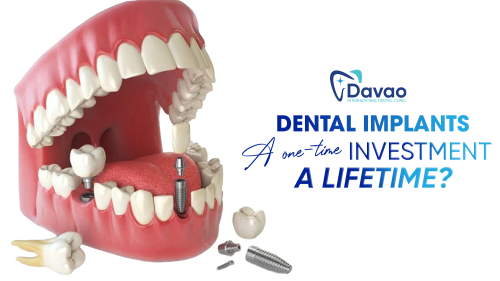
The exceptional longevity of dental implants is attributed to their three distinct yet fully integrated components, each serving a critical clinical function.
Implant Post
The implant post is made from biomedical-grade titanium, a material that has been scientifically proven to be safe and highly biocompatible with the human body. Once placed into the jawbone, the implant gradually fuses with the surrounding bone tissue, forming a stable foundation that functions like a natural tooth root. This is the key factor that allows dental implants to prevent jawbone resorption and withstand long-term chewing forces.
Abutment
The abutment is the connecting component that links the implant post to the dental crown. It helps evenly distribute occlusal forces to the implant and underlying bone, while ensuring that the crown remains securely fixed and stable during daily function.
Dental Crown
The dental crown is the visible portion of the tooth and is custom-designed to match each patient’s tooth shape, size, and color. Beyond aesthetics, the crown plays a crucial role in restoring chewing function and protecting the implant post beneath.
The clear separation between the artificial tooth root and the prosthetic crown is precisely why dental implants can last for decades, whereas other tooth replacement methods tend to deteriorate over time.

Standard Dental Implant Treatment Process
Dental implant treatment is not a single procedure, but a carefully controlled, multi-stage treatment process that requires precise evaluation of the jawbone condition, gum health, and the patient’s overall systemic health.
Step 1: Implant Placement into the Jawbone
The dentist precisely determines the position, angulation, and depth of the implant post to ensure optimal load-bearing alignment, while avoiding critical anatomical structures such as nerves or the maxillary sinus.
Step 2: Osseointegration Phase
After placement, the implant requires 6 weeks to several months to fully integrate with the jawbone. This healing period varies depending on bone quality, implant location, and individual biological response.
Step 3: Abutment Placement
Once the implant has stabilized, the dentist places the abutment, which serves as the foundation for the dental crown. This step is essential for achieving long-term stability and strength of the implant restoration.
Step 4: Crown Placement – Final Restoration
A custom-made dental crown is then securely attached to the abutment, completing the implant restoration with natural aesthetics and full functional performance comparable to a natural tooth.
Dividing the treatment into clearly defined stages is precisely what allows dental implants to achieve exceptional stability and supports their potential for long-term use.
Why Are Dental Implants Considered a “Lifetime Investment”?
Physiological Prevention of Jawbone Loss
Dental implants are currently the only tooth replacement solution capable of replacing the tooth root, allowing chewing forces to be transmitted directly to the jawbone. This physiological stimulation helps preserve bone volume and prevents bone resorption—the primary cause of facial collapse following tooth loss.
Chewing Efficiency Comparable to Natural Teeth
Dental implants can withstand approximately 90–100% of the chewing force of natural teeth, enabling patients to eat hard or chewy foods comfortably without shifting or discomfort, unlike removable dentures.
Preservation of Adjacent Teeth
Unlike dental bridges, which require grinding down adjacent healthy teeth for support, implants preserve the natural structure of neighboring teeth, reducing long-term risk to healthy dentition.
Long-Term Aesthetic Stability
Dental implants do not cause artificial gum recession or metal exposure, as seen in some traditional restorations. With proper care and maintenance, implant aesthetics can remain stable and natural-looking for many years.