
Porcelain Veneers vs. Dental Crowns: Which Option Is Right for You?
In recent years, cosmetic dentistry has become more than just a luxury—it is now an essential part of personal appearance care and overall quality of life. Many people seek dental treatment to enhance their smiles: whiter teeth, better alignment, and a more harmonious appearance when communicating.
However, when faced with two popular options—porcelain veneers and dental crowns—many patients find themselves uncertain. While both treatments can deliver attractive aesthetic results, most people do not fully understand the fundamental differences between these two approaches or which option best suits their individual dental condition.
In reality, veneers and dental crowns are not interchangeable techniques. Choosing the right or wrong treatment directly affects the degree of intervention on natural teeth, the long-term durability of the restoration, and the future health of the teeth and gums.
Aesthetic Results After Dental Crowns – A Clinical Perspective
By observing before-and-after images of full dental crown treatments, the transformation is often striking: teeth appear noticeably whiter, alignment is improved, the smile line becomes more balanced, and the overall facial appearance looks brighter and more youthful. These are typical outcomes of full-coverage dental crown restorations.
From a clinical standpoint, a dental crown is a restorative procedure in which the natural tooth is reduced to create a prepared core, followed by placement of a porcelain crown that fully covers the tooth structure. Thanks to this 360-degree coverage, dental crowns are able to:
- Completely mask severely discolored teeth
- Correct significant shape or alignment discrepancies
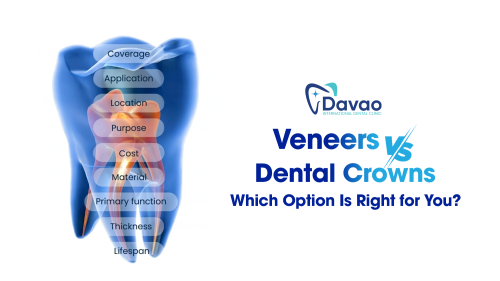
The difference between dental veneers and crowns.
- Restore teeth with structural damage, such as large cavities, extensive fractures, weakened teeth, or teeth that have undergone root canal treatment
For these reasons, dental crowns are often indicated not only for aesthetic improvement but also for functional rehabilitation of chewing ability.
However, to achieve results like those shown in clinical images, it is important to understand that the natural tooth structure must be significantly altered, making the procedure irreversible. Therefore, dental crowns are not the optimal choice for teeth that are otherwise healthy and only present minor cosmetic imperfections.
The Fundamental Differences Between Porcelain Veneers and Dental Crowns
The comparison images of veneers versus crowns in this article clearly illustrate the core differences between the two treatments. Porcelain veneers cover only the front surface of the tooth—the area that plays the most significant role in aesthetics when smiling and speaking. In contrast, dental crowns cover the entire tooth structure, functioning like a protective “armor” that encases the natural tooth underneath.
From a treatment perspective, this difference in coverage leads to entirely different clinical indications. Veneers are primarily designed for cosmetic enhancement on otherwise healthy teeth, offering gentle improvements in tooth color and shape while preserving as much natural tooth structure as possible. Conversely, dental crowns are indicated when a tooth has structural damage and requires reinforcement to ensure long-term chewing function.
Veneers are considered minimally invasive, but due to their thin design and limited coverage, they are not suitable for teeth subjected to heavy biting forces or severe damage. Dental crowns provide greater strength and load-bearing capacity, but this comes at the cost of more extensive tooth reduction and deeper intervention into the natural tooth structure.
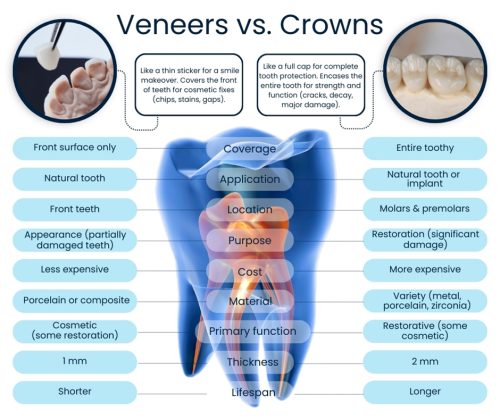
Compares dental veneers and crowns, showing their differences in coverage, function, cost, and durability
So, Which Treatment Is Right for You?
In cosmetic dentistry, there is no single solution that is “best for everyone.” A result that is both aesthetically pleasing and long-lasting can only be achieved when the chosen treatment is appropriately matched to the condition of the teeth and the individual patient’s needs.
If your teeth are healthy, with good enamel quality and stable tooth structure, and you only require minor improvements in color or shape, porcelain veneers can deliver a natural-looking enhancement while maximally preserving natural tooth structure.
On the other hand, if your teeth have large cavities, significant fractures, severe discoloration, or have undergone root canal treatment, dental crowns are a safer and more durable solution, restoring both aesthetics and chewing function.